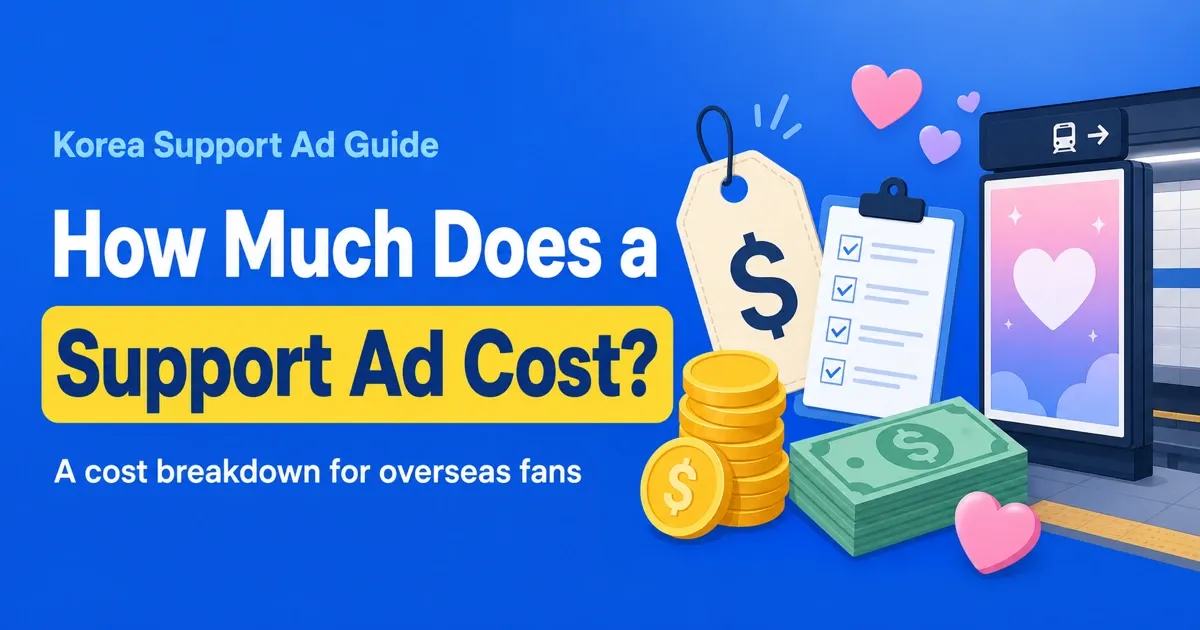
You've found the perfect station, picked the perfect photo, and you're ready to celebrate your bias with a support ad in Korea. Then one question stops you cold: "Wait… how much is this actually going to cost?"
It's the question almost every overseas fan gets stuck on — partly because the prices you see floating around online are all over the place. So let's slow down and break it into pieces. Once you can see what you're actually paying for, the number stops feeling scary and starts feeling like something you can plan for.
Mia's note
There's no single price tag — a support ad is a bundle of small costs. Understand the parts, and you can build a plan that fits your budget, not the other way around.
What you're actually paying for
A support ad isn't one fee. It's a few separate pieces stacked together. Here's the whole bundle, so nothing surprises you later.
| Cost piece | What it means |
|---|---|
| Media / placement | The biggest piece. Renting the actual space — a subway screen, a billboard, a bus — for a set period (often about 2 weeks) |
| Design | Making the artwork. You can design it yourself, ask a fan designer, or have it done for you — so this varies a lot, and is often separate from the media fee |
| Production | Printing the poster or preparing the digital file for that specific screen (sizes and formats differ by medium) |
| On-site support | Booking, paperwork, and someone on the ground in Korea — including the confirmation photos that prove it actually went live |
| VAT (10%) | Korea adds 10% VAT. Always check whether a quoted price is "VAT included" or not — it's a common surprise |
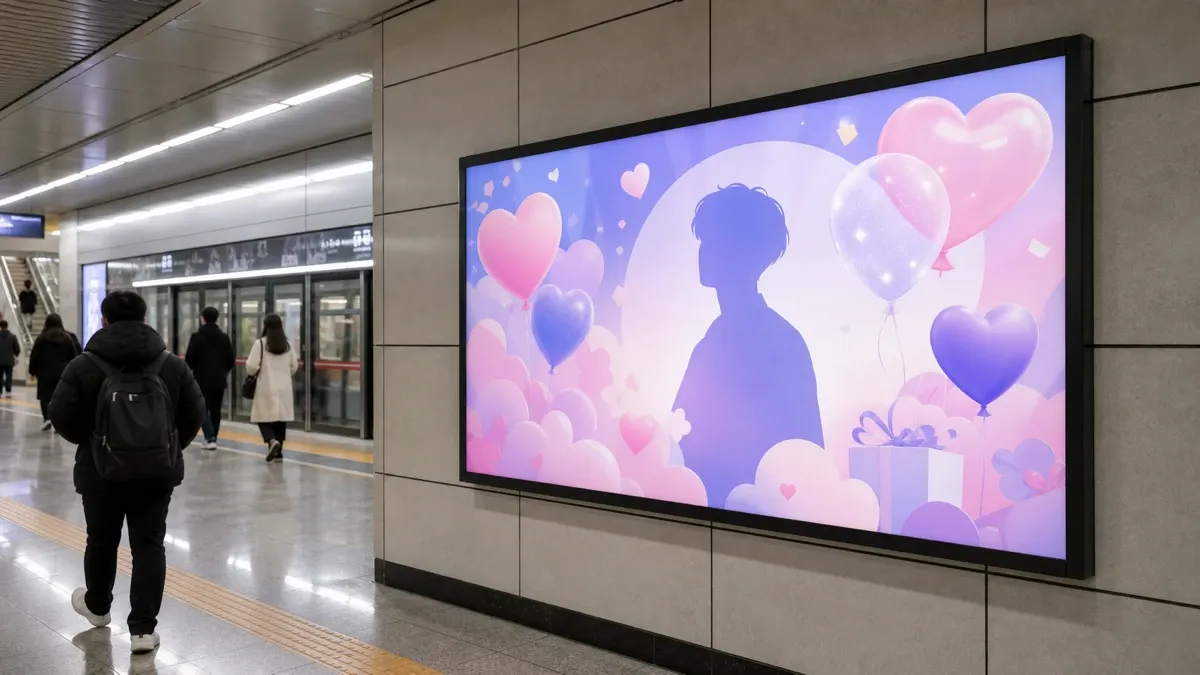
Rough price ranges by medium
Here's the part you came for — but please read it as ballpark figures, not a price list. Real costs swing with the exact location, screen size, duration, and season. Treat these as "what to roughly expect," then get a quote for your specific plan.
| Medium | Rough range | Good for |
|---|---|---|
| Subway lightbox / poster | Often around US$1,300–4,000 for ~2 weeks (before VAT), depending heavily on the station | A classic, photo-friendly first ad |
| Digital screen / billboard | Wide range — from a few hundred dollars for short loops up to several thousand for premium boards | Motion, animation, big impact |
| Bus shelter / bus | Varies by route and city; usually booked in 1–2 week blocks | A calmer, less crowded look |
| Small / cafe signage | The most budget-friendly entry point — great if you're testing the waters | Starting small, low pressure |
Numbers are rough estimates that change with location, size, timing, and the exchange rate — they're here to help you picture a budget, not to quote your project. For a real figure, you'll want a quote for the exact spot and dates.
What makes the price move
Two ads on the same subway line can cost very differently. A few things do most of the moving:
📍 Location & size
A major, busy station costs more than a quieter one. Bigger screens and premium spots cost more than standard ones.
🗓️ Duration & season
Longer runs cost more. And popular dates — like comeback or birthday seasons — fill up and can price higher.
💡 You don't have to go big to start. A small digital screen or a single poster is a completely valid first ad. Many fans start small for a first birthday, see how it feels, and scale up next time. Celebrating at all matters more than the size.

Why doing it directly in Korea costs less
Here's something a lot of overseas fans don't realize: a big part of the price can be where you book from, not just the ad itself.
When an ad is arranged through layers of middlemen abroad, each layer adds its own margin, plus handling fees, plus a currency conversion spread along the way. Booking directly with the local source in Korea strips those extra layers out — which is how the same spot can end up costing a fraction of an overseas-agency price. It's not a magic discount; it's just fewer hands in the middle.
| Where the extra cost hides | What direct booking changes |
|---|---|
| Middleman margins | Each extra layer adds its own markup — fewer layers, lower total |
| Handling & service fees | Re-billing across borders stacks fees; booking at the source keeps it simpler |
| Currency spread | Money changing hands several times adds conversion costs each time |
| A clear quote | An itemized, line-by-line quote lets you see exactly what each part costs |
The single best habit: ask for an itemized quote that lists media, design, production, support and VAT separately. If a price is just one lump sum with no breakdown, that's your cue to ask what's inside.
Quick tips before you commit
- Always confirm VAT. Ask "is this VAT included?" before comparing two prices.
- Get the quote itemized. Media, design, production, support — separately, so you can compare fairly.
- Start with a date and a budget. Work backwards from there to the medium, not the other way around.
- Book early. Popular stations and birthday seasons fill up; early planning often means more choice and calmer pricing.
- Ask about confirmation photos. You're paying from abroad — proof it went live should be part of the deal.
You can plan this — one piece at a time
A support ad in Korea isn't a mysterious lump sum. It's media, design, production, on-site support and VAT — and once you can see those pieces, you can shape a plan around the budget you actually have. Whether that's a small screen or a full subway spot, the feeling behind it is the same: you just want to celebrate someone you love. That's reason enough.
If you'd rather not juggle the pieces alone — especially from abroad — booking directly with a local team in Korea means you can ask for an itemized quote in plain language, plan the budget together, and get confirmation photos once it's up. New to the whole process? Start with Can you put up a K-pop support ad in Korea by yourself?